
Community oriented primary care (COPC) has been promoted as a way for communities and practitioners to work together in meeting health needs. A community is defined, community members identify needs, specific interventions are designed and implemented, and the process is evaluated to assess the impact. There are only a few examples where this process has been used completely and successfully around the world.
In 2001 a group of physicians from Pittsburgh began to partner with the San Jose Health Committee, a grass-roots organization seeking to improve the health of their community. The work was started in cooperation with a Cincinnati non-profit group, Shoulder to Shoulder (STS). Since incorporating as a non-profit in 2003, Shoulder to Shoulder Pittsburgh has been serving the needs of the San Jose del Negrito region, while working with the wider STS network in other parts of Honduras.
San Jose is a remote mountain village of 1600 people in El Negrito District of Yoro Province. The surrounding service area has about 5000 people. There is no electricity in >95% of the region. New poles and wires have recently been added and street lights were installed in one portion of town, but households do not have electricity. Medical care had been sporadic due to isolation and lack of adequate Honduran health manpower, but we have had a permanent Honduran RN, Carmen Meza, since 2005, and a full-time Honduran physician, Dr Tania Castillo, since late 2007. Water is piped down from mountain streams, but is often contaminated. Most homes have latrines; however 30% are still without sanitation. Intestinal parasitic disease rates are improving, with fewer diarrheas, but still remains a problem. Other major medical problems are asthma, infections, trauma and tropical diseases such as; Chagas, leishmaniasis, Dengue, and Malaria. The economy is agricultural with coffee as the main cash crop. Malnutrition among children is about 30-40%, down from the initial rates of 60%. A typical diet consists of rice, beans, and tortillas; the poorest do not have rice and eat only 2 times a day at most.
The local health committee identified the needs of more food for the children, regular medical care, a reliable supply of medicines, and more health education. We have continuously working on these issues with the local Health Committee (HC) and at the request of the HC, expanded to Dental Care with a Honduran dentist, Dr. Osario, working 15 hours a week for over a year now. In 2019 we launched a “FIRST THOUSAND DAYS” feeding and education program. We follow moms during pregnancy and then the babies for their first 1000 days of life. All moms get a dozen eggs each week, and a set curriculum of education in hopes that deeper education will lead to no more kids with malnutrition after weaning. The results thus far are encouraging. Pittsburgh physicians continue to visit 2-3 times a year to bring a team of health workers to supplement medical care, dental care and bring medications to the community. Pittsburgh churches have been very supportive in this effort with money, manpower, and supplies.
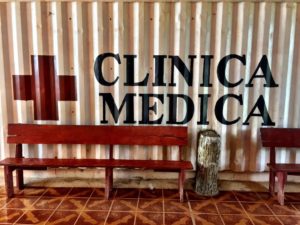
Since 2004, when our first building was completed, the community has been developing a property that now includes a Clinic building, dental clinic, maternity care unit, library, community meeting center, apartment for MD and RN, and a dormitory for visitors. The buildings have all been built by local construction workers under direction of our local Health Committee. The facilities are kept up by the community and are a source of great pride as they are some of the nicest facilities available in the region!
This project is conducted with the knowledge and support of the district health authorities, who recognize it as necessary and as meeting the expressed needs of the people of the village. It has actually increased the services and supplies allocated to the village. Collaboration is key to sustained change in the village and we strive for continued growth in this area.
Finally, medical students and residents continue to gain life forming experiences in providing medical care in a third-world setting as well as working with a developing COPC project.